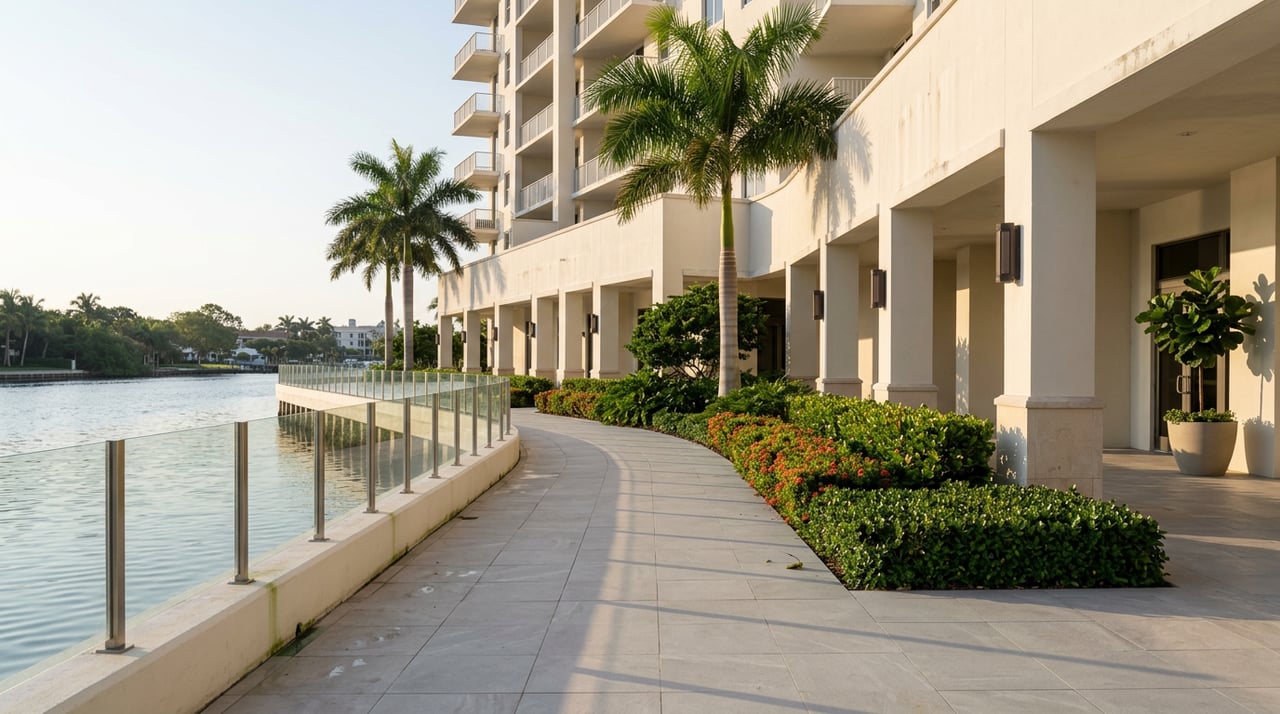
Edgewater's Saturday Finally Fits Inside a Fifteen-Minute Walk
September 17, 2026
September 17, 2026
A year ago, a Saturday in Edgewater started with a decision about which causeway to take. This September, for the first time, that decision doesn't have to happen at all.
Walk out of a tower on North Bayshore Drive this month and the day writes itself without a set of car keys. Coffee and a croissant at a counter four blocks north. A loop around Margaret Pace Park with the dog off leash in its own fenced run. A free electric shuttle to Wynwood if the afternoon calls for it. Dinner within sight of the water, at a table that wasn't part of the neighborhood's routine a year ago. None of this required leaving the neighborhood, and none of it required a car. That's the actual story of Edgewater right now, and it has nothing to do with another glass tower going up.
For most of the past decade, Edgewater's pitch to the people who already lived there was location relative to somewhere else. Leave the building, cross the Julia Tuttle or the MacArthur, do the actual living somewhere else, come back to sleep. The neighborhood had the bay and the skyline views. It didn't have much of a reason to stay on foot after 6 p.m.
That routine had a flaw nobody priced in: it made every resident's Saturday dependent on traffic, parking, and a bridge. The neighborhood was a bedroom with water views, not a place with its own daytime and evening life. What changed isn't one flashy opening. It's that four separate, fairly unglamorous decisions landed inside the same twelve months and started reinforcing each other.
Start with coffee, because that's the smallest change and the easiest to verify on foot. Péché Mignon opened at 452 NE 31st Street this year, a champagne bar and café from chef Sappir Zuzan, who trained in a two-Michelin-star kitchen in the south of France before deciding her first solo project should be something a neighbor could walk to in flip-flops. It runs 8 a.m. to 8 p.m. daily, with later hours on weekends. A few blocks south, the Cuban-coffee window at Enriquetta's has quietly become the kind of spot where people run into their neighbors, the closest thing the neighborhood has to a town square.
That's the small end of the shift. The large end is a lease. On July 7, 2026, Gioia Hospitality Group, the team behind the Michelin-recognized Daniel's steakhouse, signed for an 11,500-square-foot waterfront restaurant on the ground floor of Aimco's planned 38-story tower at 560 NE 34th Street. The space includes 2,500 square feet of outdoor dining directly on Biscayne Bay, with interiors from the Rockwell Group. Construction runs long, the restaurant isn't expected to open until late 2027 or early 2028, but the signal is immediate: a Michelin-recognized operator is betting on Edgewater's waterfront edge as a destination in its own right, not a stopover on the way to South Beach.
In between those two data points sits Amara at Paraiso, an upscale Latin restaurant directly on the bay within the Paraiso District at 3101 NE 7th Avenue, already doing the job the Gioia lease is betting on for 2028.
None of this works without somewhere to walk to and from, and that's where Margaret Pace Park stops being a footnote. The eight-acre park at 1745 N Bayshore Drive has run on the same short list of amenities for years: tennis and basketball courts, a paved loop, outdoor fitness equipment, and a half-acre dog park split into two fenced sections, one for dogs over 25 pounds and one for smaller dogs. It's functional. It has also been, by design, a modest amenity for a neighborhood that kept adding towers around it.
That's about to change on an actual construction timeline. According to reporting from the Biscayne Times, the park's community center is slated to break ground in late 2026 and run through 2028, funded through a mix of park enhancement bonds, Baywalk improvement bonds, and shoreline impact fees. The plan adds kayak launches, a renovated entrance with public art, outdoor fitness areas, and two pavilions from Touzet Studio designed as abstracted mangrove forms, one built for shaded group activities like yoga, the other a Baywalk pavilion with swings. Later phases bring pickleball and beach volleyball courts on top of the existing tennis and basketball setup.
The practical read for anyone walking the park this fall and next: construction noise will show up on the south end starting late this year, so the Baywalk segment north of NE 24th Street is the more reliable route for a quiet morning walk until the work clears in 2028. You can find the current amenity list on the city's own park page.
Here's the piece that doesn't show up on a restaurant menu or a park map, but explains why all of this is happening now instead of five years from now. A January 2026 city ordinance doubled the allowed residential density in Edgewater, from 150 units per acre to 300, and waived parking requirements for buildings that take the density bonus. In exchange, the fees collected from that bonus fund resiliency infrastructure: pump stations, seawalls, and parks; the same bucket paying for Margaret Pace Park's rebuild.
Layered on top of that is a separate rule, the Dan Paul ordinance, which requires any new building along Biscayne Bay or the Miami River to include a 25-foot public pedestrian promenade. That's the legal mechanism turning a scattered collection of private waterfront lots into one continuous Baywalk, the same walk that already connects Sea Isle Marina to Margaret Pace Park along the northern segment that opened in 2019. Every new tower is required, by ordinance, to extend that walk a little further.
The transit piece runs on its own separate logic. Freebee, the free on-demand electric shuttle service, told WLRN in February 2026 that it was doubling its Wynwood and Midtown fleet specifically to strengthen the connection into Edgewater. Managing partner Jason Spiegel explained the underlying economics of why a company gives rides away for free and still expands:
"It's reducing parking demand and it's allowing people to spend more time in these commercial districts."
That's a business rationale, not a civic one, but it lands on the resident's side of the ledger the same way. More free rides in and out of the neighborhood means fewer reasons to drive four blocks for coffee.
One more distinction matters if you're deciding how to spend an actual Saturday in September rather than reading a press release. The Pérez Art Museum Miami, sitting at the south end of the Edgewater corridor, ran a headline exhibition timed to the spring's sports calendar. "Get in the Game: Sports, Art, Culture," organized with the San Francisco Museum of Modern Art around the Miami Open, the Formula 1 Grand Prix, and the FIFA World Cup, closed on August 23. If you were waiting to catch it, that window is gone.
What's still up is quieter and runs much longer. "This Is America: Selections from PAMM's Collection," marking the 250th anniversary of the Declaration of Independence with work from artists including José Bedia, Judy Chicago, Alfredo Jaar, and Rashid Johnson, continues through May 23, 2027. Verde, the museum's on-site restaurant, gives you a bay-facing lunch without needing a dinner reservation anywhere else.
| PAMM Exhibition | Status as of September 2026 |
|---|---|
| Get in the Game: Sports, Art, Culture | Closed August 23, 2026 |
| This Is America: Selections from PAMM's Collection | Open through May 23, 2027 |
The distinction is worth making because the flashy, event-timed programming always gets the headlines and always has an end date tied to somebody else's calendar, a tennis tournament, a World Cup. The exhibit that actually serves a resident's Saturday for the next eight months is the quieter one nobody wrote a press release about.
Put the pieces next to each other and the pattern is a radius, not a list. Péché Mignon and Enriquetta's cover the morning. Margaret Pace Park, even mid-construction, covers the walk and the dog run. PAMM covers an afternoon that doesn't disappear when the World Cup leaves town. Amara at Paraiso covers dinner now, and the Gioia lease is a bet that the same waterfront strip supports a second high-end anchor by 2028. Freebee covers the trips outside that radius, to Wynwood or Midtown, without a parking app.
None of these four things would have made a Saturday work on its own. Stacked together, inside roughly fifteen minutes of walking distance from the bay, they add up to a neighborhood that finally has its own daytime and evening life instead of borrowing someone else's.
If you're already living that Saturday and you're curious what these changes mean for the building you're in or the block you walk every morning, Chuck Levine has spent his career reading exactly these kinds of shifts in South Florida's coastal neighborhoods. Schedule a free consultation to talk through what Edgewater's next two years actually look like from where you sit.
Stay up to date on the latest real estate trends.
Get assistance in determining current property value, crafting a competitive offer, writing and negotiating a contract, and much more. Contact me today.